A blog about tasting wine, from someone who has tasted that wine. Or at least looked at it. Or copied a picture of it from the internet.

Or got someone else to.

Tuesday, 1 May 2012

Catena Barrel Fermented Chardonnay

At some point, dear readers, I reviewed a lovely wine called The Sail Chardonnay. It was bloody marvellous. This is actually background information....

Sorry. I'll start again.

At some point, dear reader, I reviewed a lovely wine called ohhhhh wait I did that. The real background information is thus...

Chablis is a classic style - for many the classic style - of Chardonnay. Chablis itself is indeed the best-known form of this style (which for the sake of argument is the Chablis style). The Sail Chardonnay, previously reviewed, was deeper and richer than Chablis, but retained aspects of the crisp, fresh approach. Catena Chardonnay does NOT retain these aspects. Catena is the absolute opposite of Chablis. Except that Catena is a brand and Chablis is a region. And they have things in common, like being a wine, and white, and in a bottle - but meh, you get the gist. Catena is barrel fermented. What in the name of Jesus does that mean? Honestly, I have no idea. Well, I have a vague idea, but too vague to have any chance at all of explaining it to anyone else. However, the end result is thus: buttery; biscuity; vanilla; rich; full bodied. Yes, full bodied. Why the hell not?

This post is for two types of people
 1) You don't like white wine because it all tastes the same / rubbish / like Jacob's Creek
2) You think all Chardonnay tastes like Chablis and you like it / don't like it / I don't care

If you are one of these, go and buy something like this. Or actually this. Have it with roast chicken/vegetables/smash.

PS. sorry about using the word 'thus'. But I actually really like it as a word. Thus I use it a lot.

Wednesday, 25 April 2012

Le Cochon Noir

The Black Pigs Shiraz and 16 Little Black Pigs Pinot Grigio. What do these two wines have in common? Well, you've probably noticed the similar titles. Even an idiot (and you probably are one merely for considering reading this blog) could guess they are made by the same people. However, one is white, and one is black. If it was 1981 and we were in Brixton the latter would be rioting and the former probably committing a racially motivated act of aggression while wearing a black and white hat. Although ironically the white one is called '16 little black pigs' which has whole strands of confusing converse implications in reference to police brutality. Anyway that's enough personification of the wine, I'm getting lost.

Other things in common;
They both cost around the £10 mark.
The are both excellent wines.
They are both excellent benchmarks at this price.

16 Little Black Pigs Pinot Grigio 2011The Black Pig Single Vineyard Clare Valley Shiraz 2010

Why such good benchmarks?
Well, both are great examples of single-grape wines made in a fairly usual style - the Pinot Grigio is crisp and punchy, the shiraz deep, powerful and fruity. They aren't staggeringly interesting but neither is there anything at all you can find wrong with them (except the racial thing). Neither are incredible for the price tag, but both are nonetheless excellent. A better wine would be a poor benchmark, providing unfair expectation for comparison, but a worse wine as a benchmark would leave you buying more poor wines without realising you're being thoroughly shafted. These then are great examples of what - perhaps - you should get for ten of your shiny golden nuggets sterling. You might find better, but you certainly shouldn't expect it.

Tuesday, 24 April 2012

Following two months of travelling throughout south east Asia - hence the rather quiet blog - a few musings regarding wine have come to light.

Firstly, almost everything in SE Asia is cheaper than in Europe. Almost everything, but not wine. The vast majority is imported from France or Australia, with still good proportions from the other premier wine-making areas of the world in larger retailers. Prices are fairly comparable with the UK because they have to buy it at the same prices and then import it even further, which probably balances against the ridiculous import tax in the UK. You can occasionally get your hands on some local wine, some of which is actually pretty good, though. In Thailand we tried a great Shiraz grown in the cooler northern part of the country; in Vietnam we had a bottle of something like sauv blanc which cost in the region of £1.50 and was fairly drinkable - you wouldn't have poured it down the sink (although you might have saved it for cooking). The 'rice wine', on the other hand, you probably wouldn't pay for. To describe it as wine is a disservice to wine - it's basically vodka made from rice. It tastes horrible, but is excellent for breaking through the language barrier!!

One interesting thing about the big wine retailers in the big cities over there (I'm thinking Bangkok, Kuala Lumpur, Hanoi) is that every one has a cabinet containing the biggest names in wine. Usually all of them. While in the UK you might walk into a decent wine shop and see a Chateau Lafite or Margaux, probably behind bullet-proof glass, in Asia they are everywhere that sells wine. If you walk into a full-sized wine retailer in any of the above cities and they don't have pretty much all of Chateaux Latour, Lafite, Margaux, Palmer, Baron Rothschild, Yquem, Haut Brion, Lafite Rothschild, Pichon Longueville etc etc... I'd be pretty surprised. If you could steal that specific cabinet you'd have about a hundred grand of wine on you. This situation can only be attributed to the wider obsession with names, with brands, with logos, which is so strong in Asia. I'd heard that the prices of pauillac grand cru classé wines increased exponentially as Chinese businessmen began to appreciate good wine, partly because in political and business circles it would be insulting to not be serving Lafite (or whatever) if that happens to be known to be the best wine around. You are taking a big risk serving anything other than the most expensive wine you can lay your hands on... especially as the competition might.

The above issues unfortunately rapidly prices such wines out of the market for the mere mortal. On the other hand, if you go to The Sampler (http://www.thesampler.co.uk/store/) you can try a small glass of a variety of ludicrously expensive wines without buying the bottle for several hundred quid. While The Sampler is presumably just trying to make a bit of cash with a good idea, there is something rather cheering about the prospect of being able to turn up with £20 in your pocket and try two or three of what really should be spectacular wines. It's an opportunity for someone like me, who can only claim to have at best little knowledge about medium priced wines, to go and see what all the fuss is about. Just don't take too much cash, it's bloody easy to spend a LOT of money there. And don't try drinking anything that needs serious cellaring, you can also pay a LOT for a wine that isn't ready to drink and they aren't shy of letting you.

Sunday, 15 January 2012

Chateau Musar 2004

What we have here is one of my favourite wines yet. I can't explain why it stands out so much - it has more than one aspect in its flavour, some intrigue, that I've not quite tasted in any other wine. OK so it costs only a fraction short of £20 a bottle for this vintage, and I know what you're going to say - I could get four bottles of Black Tower's finest red for the same price. Surely only a madman would suggest that a single bottle of wine, which will only get you quite pissed, could possibly be as good as four bottles of wine, each of which will get you quite pissed. Or, if you drank them all in one go, hospitalised? I agree, it's hard to make the argument. But I have to.


Firstly, let's acknowledge that quality of wine affects your hangover. Drinking four bottles of Black Tower won't give you a four times worse hangover than drinking one decent bottle of wine, it'll be about nineteen times worse. You'll be convinced Apocalypse Now is reality, silently murmuring 'the horror, the horror' while images of the black tower of Mordor circle in your crumpled waterless brain. Secondly, if you've ever had wine that's impossible to drink without making the face of a dying antelope, you'll probably not want to consume utter shite anyway - afterall, Tenants Super is even cheaper, but for some reason twenty cans of that was out of the question before we started. Finally, until you've drunk what I think is the better one, you'll not be able to call me a pompous tosser for thinking it's so amazing. Surely £20 isn't too high a price to pay to be able to insult me to my face when you realise I'm utterly wrong?


Well, if that's not persuaded you, how about this picture of a nice chap in the cellar of Chateau Musar. Imagine, you could be drinking with him - that'd be really special.

Saturday, 14 January 2012

McGuigan Black Label Merlot 2010

I'm starting to rather like McGuigan as a producer. The last McGuigan was one of the best value wines I've had, and this is in the same league. It's nowhere near as exciting and different as the red version, but it's still punching above its price and proving that some mass produced wine can be pretty good. Try the Black Label Shiraz first though, unless merlot is your preferred red tipple - this is good but the other is a proper surprise for something well under £10, and mixes a treat with spicy asian food, something few reds achieve. In fact I'm wondering if I should've just reviewed that one again. Balls.

Friday, 30 December 2011

Varied Festive Vino

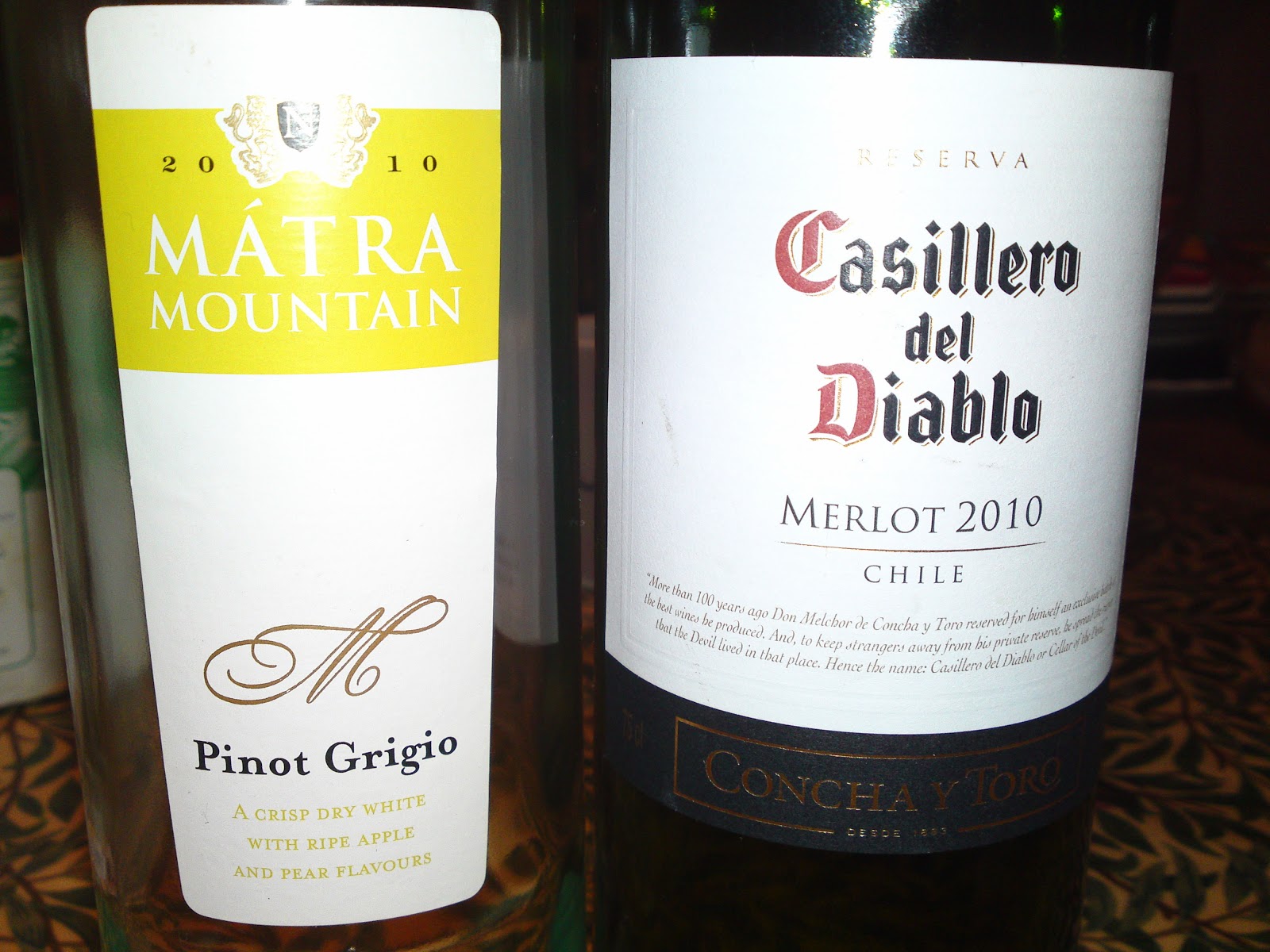
Matra Mountain Pinot Grigio 2010 - This goes down for me as the benchmark for good value Pinot Grigio. The apple and pear flavours shine through so strongly you can imagine identifying them without reading the label. Well worth a try, and at £6 beats all the PGs I've tried so far, most of which were not so cheap.
Casillero del Diablo Merlot 2010 - You've seen Casillero for sale for sure, it's everywhere. Often that would mean it would be bad, as mass produced = shite. That's not totally true here, it's not outstanding value but is a label which produces reliably decent wines at below and upto the £10 mark. Worth a punt if nothing else takes your fancy. This one was all blackcurranty goodness, strong for a Merlot.

Barolo Vendemmia 2007, Brazin Old Vine Zinfandel and a bonsai tree. Of the three, drinking the tree was probably the most appalling decision. Barolo, made from the Nebbiolo grape, makes other powerful rich wines seem like tiny little children trying to climb up your legs, while the bully Barolo smashes your face in with a coal shovel. Not for the weak. Definitely for those who are convinced deep and devastating wines are for them. Overall however, I preferred the Zinfandel, which was rich and powerful but with a little give. I'm not sure it quite justified the price tag though. Both Waitrose.
Two dessert wines here, both from Sainte-Croix-du-Mont in Bordeux. Somehow, they are completely different. The Chateau Loubens 1997 is practically the colour of gold, rich beyond belief for a wine, and pairs perfectly with exceptionally sweet desserts and salty cheeses. The Chateau La Rame 2009 was far drier and less singularly powerful, and although the colour would be exciting compared with any other white, next to the 1997 it looked weak and pale - the picture does this no justice. I can't say I enjoyed it less though, and it went better with more moderate cheeses and desserts.

I would recommend trying a dessert wine if you haven't - it's an odd experience even if you decide it's not for you. Obviously, don't have it without food, or it'll be like drinking milkshake syrup but without the sugar high which is the main reason for doing so. Unless it's for a bet.

And so to the end of the festival of festive fun-fest, with a Sancerre and a Pouilly-Fuissé. It's Sauvignon Blanc versus Chardonnay and neither comes out the winner.  Sancerre has always been a personal favourite, but both are really interesting examples of their grape and I don't have the wine knowledge to explain how so er... balls.